A major stereotype of Japanese culture is an overwhelming seriousness, encapsulated in the concept of majime. This translates to seriousness or soberness, implying a lack of emotion and straight-facedness linked to the working world. The personification of majime is the salary man who works long hours, spends all his life in one job and sees his tenure as a badge of honour, an emblem to be wielded as fiercely and as proudly as a samurai with his katana.
But is majime a stereotype or can it have certain benefits when looked at from the wider perspective of Japanese culture? Let’s explore that in more detail and see what that looks like from a mental health perspective.
Majime as a societal construct
Majime has similarities with other Japanese concepts like gaman, the idea of staying resilient in the face of adversity. Where I think majime differs is in the distinction between toughness and seriousness. Toughness is a quality that’s often praised, even exalted as a ‘cure’ for anything remotely bad that the world throws at you.
Seriousness generally has more negative connotations. Oh, she’s a bit serious, isn’t she? Wow, maybe he could stand to lighten up a bit. These societal cues can be read between the lines when someone is described as serious. So, in that sense, I think majime has more in common with the Japanese ideas of honne and tatemae.
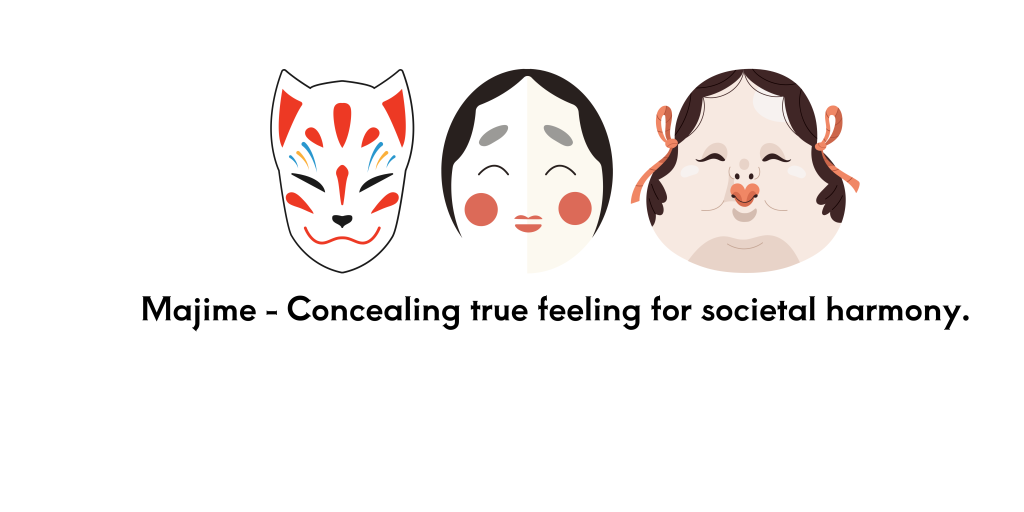
Honne refers to the practice of keeping true feelings concealed and tatemae is a surface level politeness meant to keep groups functioning harmoniously. In public, what you’re thinking isn’t expressed and should only be revealed to your friends and loved ones.
For me, majime is the representation of the ‘mask’ that many Japanese wear when they’re practicting both honne and tatemae. Expressions are limited by that mask and work as a coping mechanism for dealing with stressful work cultures and pressuried environments.
Letting the mask slip
In contrast to the seriousness that’s put on the surface at work, the mask of majime often slips in the night time hours. Co-workers are expected to gather, drink and socialise, with a common saying of older generations being ‘if you want to work your way up the corporate ladder you have to drink.’
With so much pressure in the day, it’s little wonder that people want to let their true selves be revealed, at least until the sunrise. And while there are still traces of the relentless salary man drive and expectation to be serious about drinking and observing tradition, things are changing for the better. It’s become more acceptable to refuse drinks during parties and adopting a measured perspective.
As one observer has revealed for dealing with Japanese drinking culture etiquette “If you are invited to nomikai, I do not recommend that you decline outright. You should participate because it will help with relationship building. You absolutely do NOT need to drink alcohol.
However you will need to drink something, otherwise you won’t be able to participate in the ‘kanpai’ toast and the drink pouring activities thereafter with your colleagues. In the past oolong-tea was the go-to beverage for people who did not drink. This is fine, but it makes you stand out because the colour and appearance are very different from beer. I would recommend non-alcoholic beer instead, which should be standard fare at any izakaya (Japanese pub).
Regarding pub-hopping, I recommend that you do not leave early. At the very least, you should stay until the end of the first leg of the event. This is because it is very likely that a manager or somebody of importance will say a few words in closing and possibly do a group ‘clap’ or something similar that involves everyone’s participation. After this, feel free to go back to your hotel. You do NOT need to go to the next pub with everybody else, i.e. nijikai.
Regarding the AA perspective: I can almost guarantee that you will not be going to a ‘bar’. You will be going to an ‘izakaya’. This is basically a restaurant that serves a wide variety of sharable Japanese (and possibly Western) dishes with alcohol also available. Food and drink are intertwined in Japanese culture, and you should think of them as a set. People do not normally go out to just drink alcohol (unlike the West).”
Japanese night life isn’t the only area where the mask of majime slips. Anime and manga seems to be the ideal medium for expressing a love for playfulness, joy and irreverence. Freed of societal expectations, Japanese anime and manga creators can be as weird as they like and play by the rules of a medium that expects playfulness and creativity.
So, like many Japanese societal constructs, majime is multi-faceted and can do as much good as harm. On one hand, it helps people conform if that is expected of them in specific situations. On the other hand, it can stifle the ability to speak freely and be independent.
For an exploration of other Japanese concepts like gaman and mono no aware, check out my book Japanese Fighting Heroes: Warriors, Samurai and Ronins. The book tells the stories of Japan’s most famous figures like Date Masamune and Miyamoto Musashi, while separating fact from fiction.

 yamatomagazine.home.blog
One thought on “The Mask Of Majime – What Is The Price Of Extreme Politeness?”